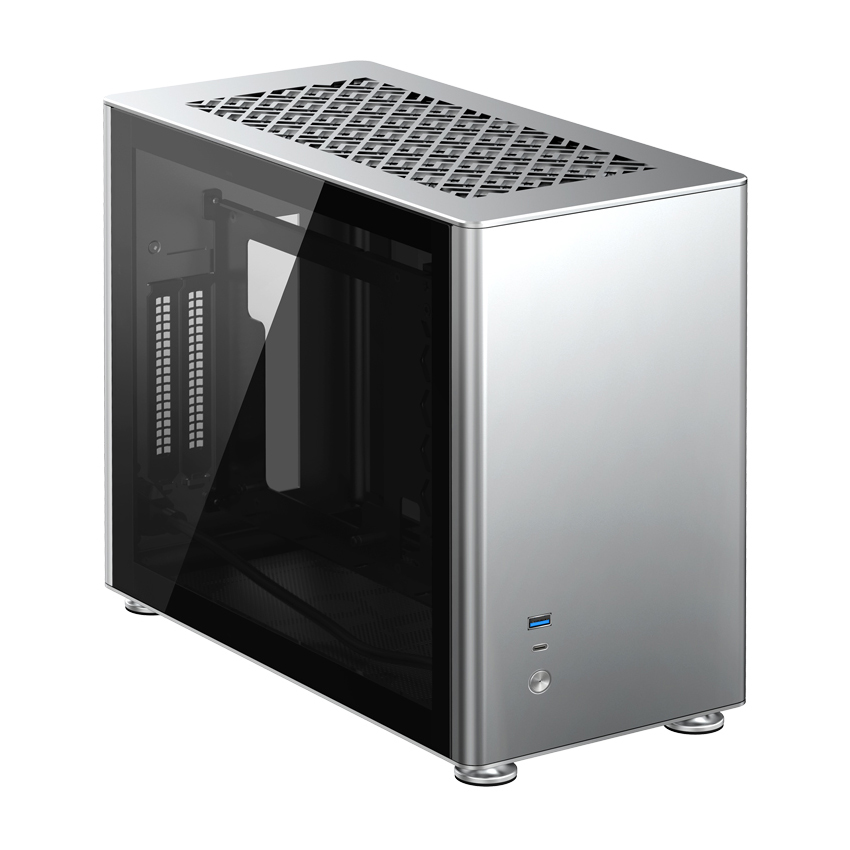
The Architecture of Elegance: An Introduction to the Jonsbo A4
The world of Small Form Factor (SFF) computing is often a battleground between size and thermal sanity. For years, builders had to choose: do you want a tiny PC that runs hot and loud, or a larger “Mini-ITX” case that is basically a mid-tower in disguise? The Jonsbo A4 Silver was born to end that conflict. By utilizing a “sandwich” layout—pioneered by boutique brands but refined here with premium mass-production techniques—the Jonsbo A4 creates a spectacularly efficient $15.6$-liter volume that houses full-sized enthusiast hardware while looking like a piece of high-end audio equipment.
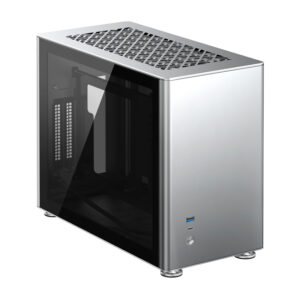
The first thing you notice about the Jonsbo A4 is its materiality. While many competitors rely on stamped steel or plastic shrouds, Jonsbo uses a $3$mm thick aluminum-magnesium alloy for the exterior. This isn’t just for show; the thick metal acts as a structural exoskeleton, providing a rigidity and premium “heft” that is immediately apparent. The sandblasted silver finish is specifically designed to resist fingerprints and catch the light in a way that highlights the CNC-machined precision of the top and bottom vents. It is, quite simply, a spectacular visual statement for any workspace or gaming setup.
The Sandwich Philosophy: Form Meets Function
The core of the Jonsbo A4 design is its internal division. In a traditional case, the GPU sits directly below the CPU, often sharing the same pool of stagnant air. In the Jonsbo A4, the case is split into two distinct vertical chambers:
-
The Left Chamber: Reserved exclusively for the Graphics Card. By mounting the GPU vertically, its fans pull fresh air directly from the side, isolated from the CPU’s heat.
-
The Right Chamber: Houses the Mini-ITX motherboard and the power supply.
This separation is facilitated by a high-quality PCIe 3.0 x16 riser cable (included), which wraps behind the motherboard tray. This layout is spectacularly effective because it allows both the CPU and GPU to act as independent thermal zones. When you look through the dual tempered glass panels, you see a clean, organized split: on one side, the “brain” of the operation; on the other, the “muscle.”
Vertical Airflow: The Chimney Effect
Heat naturally rises, and the Jonsbo A4 is engineered to capitalize on this fundamental law of physics. Known as the “Chimney Effect,” the airflow path in the Jonsbo A4 is strictly vertical.
-
The Intake (The Floor): The case sits on four magnetic aluminum feet, raising it high enough to allow two $120$mm fans to pull cool air from the bottom.
-
The Exhaust (The Ceiling): Two $120$mm fans at the top (or a $240$mm radiator) act as the primary exhaust, pulling the rising heat out of the case.
Because the side panels are tempered glass, there is no side-ventilation turbulence to disrupt this column of air. This makes the Jonsbo A4 spectacularly predictable in its cooling performance. As long as you have high-static pressure fans at the bottom, the air has nowhere to go but up, sweeping past the VRMs and the GPU backplate on its way out. It is a simple, elegant, and highly effective thermal solution that keeps even high-TDP components within safe operating margins.
Liquid Cooling Mastery: The 240mm Advantage
Most cases in the sub-$20$L category struggle to fit an All-In-One (AIO) liquid cooler. The Jonsbo A4 makes it a priority. The top bracket is spacious enough to accommodate a $240$mm radiator with a total thickness (radiator + fans) of up to $52$mm.
This is a spectacular feature for users running modern Intel Core i7/i9 or AMD Ryzen 7/9 processors. While low-profile air coolers often top out at $95$W or $105$W TDP, a $240$mm AIO allows the Jonsbo A4 to handle sustained $150$W+ loads. This means you can build a legitimate workstation or a $4$K gaming powerhouse in a case that fits inside a backpack. For the purists, the case also supports air coolers up to $71$mm in height, making it compatible with the legendary Noctua NH-L12S for a silent, air-cooled build.
GPU Compatibility: Feeding the Beast
As graphics cards continue to grow in size, many SFF cases have become obsolete. The Jonsbo A4 was designed with the future in mind. It supports GPUs up to $325$mm in length. This clearance allows you to install many triple-fan models that would be unthinkable in other ITX cases.
The vertical mount in the Jonsbo A4 is more than just an aesthetic choice; it’s a necessity for weight management. By hanging the GPU vertically, you eliminate “GPU sag” that can damage motherboards in traditional layouts. Furthermore, because the card is positioned right against the tempered glass, any RGB elements on the shroud or fans are presented in a spectacular display. For users concerned about thermals with glass panels, Jonsbo’s vertical airflow design ensures that the exhaust fans at the top are constantly pulling the GPU’s hot air away before it can soak into the glass.
Powering the Build: SFX and SFX-L Support
A high-end system needs high-end power. The Jonsbo A4 supports both SFX and SFX-L power supplies. The inclusion of SFX-L support is a spectacular win for noise-sensitive users, as SFX-L units typically feature larger $120$mm fans that spin slower and quieter than the $80$mm or $92$mm fans found in standard SFX units.
The PSU is mounted in the front of the right chamber, covered by a sleek aluminum shroud that helps hide the mess of cables. This “hidden” PSU mount is a stroke of genius, as it keeps the center of the case open for airflow while providing a mounting point for two 2.5″ SSDs. It’s a multi-functional use of space that is typical of the Jonsbo A4 design philosophy: every millimeter must serve a purpose.
Storage Versatility and Expansion
In $2026$, NVMe M.2 drives are the standard, but many users still rely on SATA drives for bulk storage. The Jonsbo A4 offers a surprising amount of storage flexibility for its size:
-
Dual 2.5″ Mounts: Located on the PSU shroud, these allow you to show off your high-end SSDs or hide them behind decorative plates (included).
-
Bottom 3.5″ Mount: If you need a high-capacity mechanical drive, the Jonsbo A4 allows you to mount one $3.5$” HDD at the bottom.
Note: Installing a $3.5$” drive at the bottom will require you to remove one of the $120$mm intake fans. While this is a trade-off, it is spectacular that the option even exists in a case this small. For most users, the combination of two M.2 slots on their motherboard and two 2.5″ SSDs in the case will provide more than enough storage for a massive game library and creative assets.
The “Hidden” Details: Cable Management and I/O
Building in an SFF case is often described as “playing Tetris with wires.” The Jonsbo A4 attempts to soothe this pain with a well-thought-out cable routing path. There is a dedicated gap between the chambers that allows you to route the $24$-pin and $8$-pin cables with relative ease.
The front I/O is a masterclass in minimalism. You get a single, premium-feeling power button, one USB 3.0 Type-A port, and one USB 3.1 Gen 2 Type-C port. The inclusion of Type-C is spectacularly important in the modern era, allowing for high-speed data transfer to external drives and easy connection for modern peripherals. The ports are positioned on the side of the front panel, keeping the face of the Jonsbo A4 completely clean and unobstructed.
Build Quality and Maintenance
Maintenance is often overlooked in SFF cases, but the Jonsbo A4 handles it with grace. The top panel is held in place by friction and a rear slide-lock mechanism. Once the top is removed, the two tempered glass side panels can be lifted straight out—no screws, no tools, no hassle. This makes cleaning your components or swapping out a GPU a spectacularly fast process.
To keep the interior clean, Jonsbo has included a magnetic dust filter for the bottom intake. Given that the bottom fans are the primary source of air, this filter is critical for preventing the case from becoming a “dust magnet.” The CNC-machined vents on the top and bottom are also designed with a specific pattern that balances airflow with structural integrity, ensuring that the Jonsbo A4 remains quiet even when the fans are at full tilt.
Premium Touches: The Unboxing Experience
When you purchase a Jonsbo A4, you aren’t just getting a box of metal. Jonsbo includes several high-end accessories to ensure a successful build:
-
ADT-Link PCIe Riser: A high-end, shielded riser cable that ensures signal integrity for your GPU.
-
Magnetic Feet: Four solid aluminum feet with rubber dampeners that screw into the base, providing the necessary clearance for bottom intake.
-
Acrylic Inserts: If you don’t use the 2.5″ SSD mounts, Jonsbo provides laser-etched acrylic plates to fill the space, one of which even features a storage slot for the included Allen wrench.
These small touches transform the Jonsbo A4 from a standard computer case into a boutique experience. It is this attention to detail that makes the case feel like a spectacular value, even when compared to much more expensive “kickstarter” SFF cases.
Thermals in the Real World: What to Expect
Because the Jonsbo A4 uses tempered glass on both sides, it relies entirely on its vertical airflow. In testing, this setup performs remarkably well. With a $240$mm AIO at the top and two $120$mm fans at the bottom, a mid-to-high range CPU will typically hover around $65$°C to $75$°C under gaming loads. The GPU, having its own dedicated air intake right against the glass, usually stays within the $70$°C range.
For the absolute best results, we recommend using high-quality static pressure fans (like the Noctua NF-A12x25 or Phanteks T30) for the bottom intake. This ensures that the air is forcefully pushed up through the chassis, overcoming the resistance of the internal components. When configured correctly, the Jonsbo A4 is a spectacular performer that can trade blows with much larger mid-tower cases.
Who is the Jonsbo A4 For?
The Jonsbo A4 Silver is a specific tool for a specific builder.
-
The Aesthetic Enthusiast: If you want your PC to be a piece of art on your desk, the sandblasted aluminum and dual glass of the Jonsbo A4 are unbeatable.
-
The Space-Saver: At $15.6$L, it fits on even the smallest of dorm or apartment desks.
-
The Power User: With support for $325$mm GPUs and $240$mm AIOs, you don’t have to compromise on performance.
It is not a case for “budget” builders who want to use a standard ATX PSU or a $3.5$” HDD array. It is a case for the modern enthusiast who values precision, materials, and a spectacularly clean internal layout.
Final Verdict: A Modern SFF Icon
The Jonsbo A4 in Silver is a triumph of design. It takes the proven sandwich layout and wraps it in a shell of premium aluminum and glass that rivals the build quality of cases twice its price. It challenges the notion that small cases must be difficult to work in or thermally compromised. By focusing on vertical airflow and providing generous support for liquid cooling and full-sized GPUs, Jonsbo has created a chassis that is as functional as it is beautiful.
Whether you are building your first SFF rig or your tenth, the Jonsbo A4 offers a spectacular building experience that rewards careful cable management with a museum-grade result. It is a case that you will be proud to display, and one that will serve as the cold, quiet heart of your setup for years to come.
For the most up-to-date compatibility lists regarding the latest RTX 50-series and RX 8000-series cards, please consult the official Jonsbo A4 technical datasheet.